Lapple cyclone
Select calculation method
Input data
Diameter cut
Minimum particle diameter to be plotted
Maximum particle diameter to be plotted
Graph points
Output data
Graph
Grade curve
Efficiency values
Units
Particles size ratio
Units
Description
The Lapple cyclone is a widely used device for separating solid particles from gases through centrifugal force. It provides a simplified yet effective model to estimate separation efficiency, pressure drop, and power requirements in ventilation and exhaust systems.
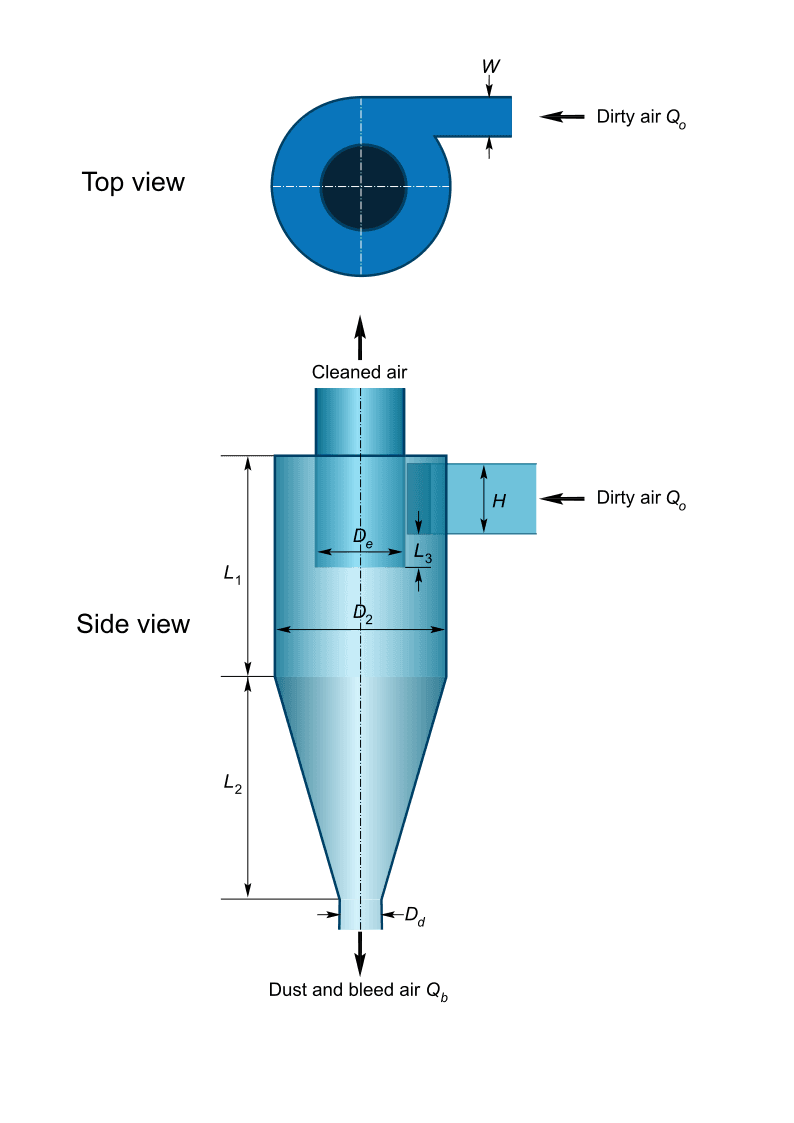 Lapple Cyclone
Available calculation methods:
- Dimensions – computes main geometric parameters, cut diameter, pressure drop, and power.
- Granulometric curve – generates the grade efficiency curve as a function of particle size.
- Granulometry from the cyclone diameter – calculates the outlet granulometric distribution based on the cyclone diameter.
- Granulometry from the diameter cut – estimates outlet granulometric distribution using a predefined cut diameter.
Inputs and outputs of the dimension calculation
Inputs
| Parameter | Default units | Description |
|---|---|---|
| Cyclone diameter () | m | Main dimension of the cyclone |
| Particle density () | kg/m³ | Solid particle density |
| Air flow () | m³/s | Volumetric airflow |
| Air density () | kg/m³ | Carrier fluid density |
| Air viscosity () | Pa·s | Dynamic viscosity of air |
| Blower efficiency () | % | Efficiency of the fan |
Outputs
| Parameter | Default units | Description |
|---|---|---|
| Cut diameter () | m | Particle diameter at 50% collection efficiency |
| Head loss () | Pa | Pressure drop across the cyclone |
| Power () | W | Power required for operation |
| L1, L2, L3 | m | Characteristic heights of the cyclone |
| W | m | Inlet width |
| Dd | m | Discharge duct diameter |
| H | m | Cylindrical body height |
| De | m | Exit diameter |
References
- CIMBALA, J. M. Lesson 12B: Lapple Cyclone. A Practical Application of Inertial Separation.