Lapple cyclone
Select calculation method
Input data
Cyclone diameter
Particle density
Air flow
Air density
Air viscosity
Blower efficiency
Output data
Cut diameter
Head loss
Power
L1
L2
W
Dd
H
De
L3
Description
The Lapple cyclone is a widely used device for separating solid particles from gases through centrifugal force. It provides a simplified yet effective model to estimate separation efficiency, pressure drop, and power requirements in ventilation and exhaust systems.
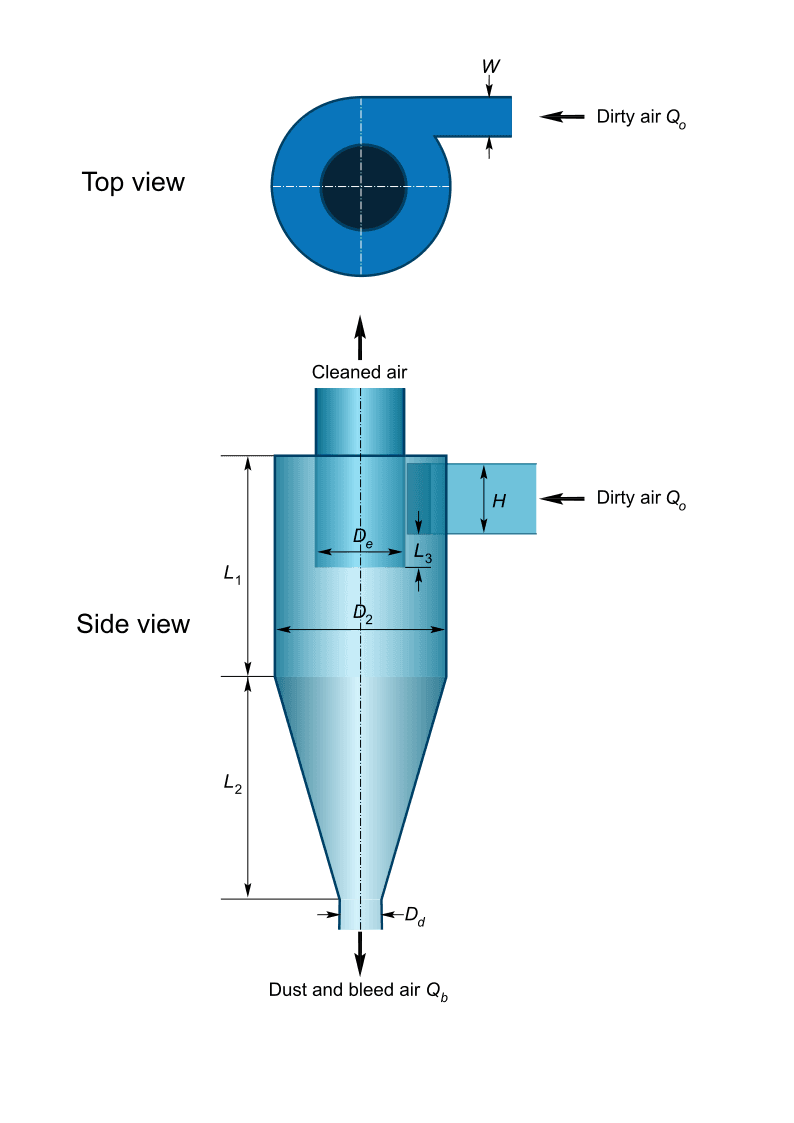 Lapple Cyclone
Available calculation methods:
- Dimensions – computes main geometric parameters, cut diameter, pressure drop, and power.
- Granulometric curve – generates the grade efficiency curve as a function of particle size.
- Granulometry from the cyclone diameter – calculates the outlet granulometric distribution based on the cyclone diameter.
- Granulometry from the diameter cut – estimates outlet granulometric distribution using a predefined cut diameter.
Inputs and outputs of the dimension calculation
Inputs
| Parameter | Default units | Description |
|---|---|---|
| Cyclone diameter () | m | Main dimension of the cyclone |
| Particle density () | kg/m³ | Solid particle density |
| Air flow () | m³/s | Volumetric airflow |
| Air density () | kg/m³ | Carrier fluid density |
| Air viscosity () | Pa·s | Dynamic viscosity of air |
| Blower efficiency () | % | Efficiency of the fan |
Outputs
| Parameter | Default units | Description |
|---|---|---|
| Cut diameter () | m | Particle diameter at 50% collection efficiency |
| Head loss () | Pa | Pressure drop across the cyclone |
| Power () | W | Power required for operation |
| L1, L2, L3 | m | Characteristic heights of the cyclone |
| W | m | Inlet width |
| Dd | m | Discharge duct diameter |
| H | m | Cylindrical body height |
| De | m | Exit diameter |
References
- CIMBALA, J. M. Lesson 12B: Lapple Cyclone. A Practical Application of Inertial Separation.